GA-Alliance stands as one of the leading law firms in the energy sector, renowned both nationally and internationally. We offer a broad range of legal services tailored specifically to the energy sector, delivering strategic advice and legal assistance across a diverse range of issues.
Our core strengths encompass:
Interdisciplinary assistance: GA-Alliance excels in providing interdisciplinary support in extraordinary transactions, energy infrastructure project development, commercial contracting, trading, administrative and regulatory law matters, as well as litigation and national and international arbitrations.
Sector Experience: with a team boasting extensive experience across all branches of the energy sector, including oil & gas, fossil and renewable generation and energy efficiency, we are able to assist clients in international transactions, offering targeted and in-depth guidance.
Energy Plant Financing: We boast a proven track record in facilitating the financing of energy generation plants, providing expert assistance at every stage of the financing process to ensure seamless execution.
Energy Infrastructure: GA-Alliance professionals possess substantial expertise in the energy infrastructure sector, spanning ports, airports, motorways, electricity and rail networks, gas pipelines and water networks. Our comprehensive support extends to regulatory aspects, M&A transactions, project finance, EU legislation, tax aspects, antitrust matters and litigation management.
Thanks to our experience and expertise in the energy sector, we provide our clients with top-tier legal advice to address the complex and dynamic challenges of the energy market.
GA-Alliance lands in Pakistan: strategic partnership signed with Axis Law Chambers
MILAN – 29 January 2026
GA-Alliance, a global legal and tax firm with more than 2,600 professionals in 80 countries, announces its entry into the Pakistani market. The strategic partnership with Axis Law Chambers, a leading full‑service law firm in the region, marks a further expansion of GA‑Alliance’s network, which today covers geographies that generate nearly 90% of global GDP.
The agreement strengthens GA‑Alliance’s commitment to its “one‑stop‑shop” strategy. By integrating local expertise with the highest global standards, the Alliance offers clients a single, efficient access point for all legal and tax needs. This model removes the complexities of managing multiple advisers across different jurisdictions, delivering a coordinated and seamless experience that prioritizes clarity and business growth.
Axis Law Chambers brings to the Alliance a reputation for excellence, particularly in high‑value cross‑border mandates and advice on complex regulatory matters. Regularly listed by Chambers and Partners and The Legal 500, Axis Law stands out for its transactional work in corporate matters, mergers and acquisitions (M&A), employment law, intellectual property, foreign investment, public‑private partnerships, corporate governance, antitrust, tax, data protection and sectoral compliance. The firm advises clients in key industries such as energy, oil & gas, mining, healthcare, telecommunications, automotive, financial services, defense, retail, manufacturing, agriculture, media, IT, logistics, real estate and non‑profit organizations.
Axis Law also boasts one of Pakistan’s most authoritative dispute resolution practices, including litigation and international arbitration, with solid experience in proceedings before ICSID (International Centre for Settlement of Investment Disputes, based in Washington, D.C., and part of the World Bank), ICC (International Chamber of Commerce, based in Paris) and LCIA (London Court of International Arbitration, based in London). This depth of expertise ensures GA‑Alliance clients receive top‑level support in the world’s fifth most populous country, one of the most dynamic economies in Asia.
Francesco Sciaudone, Managing Partner of GA‑Alliance, emphasized the strategic importance of the operation: “Our entry into Pakistan through the partnership with Axis Law Chambers is another step that strengthens our global growth path. At GA‑Alliance, the goal is to simplify complexity for our clients. By extending our ‘one‑stop‑shop’ model to an outstanding Pakistani firm, we are increasingly able to offer our clients the ability to operate with confidence in a very large number of markets worldwide. We are not only expanding our geographic presence; we are enhancing a sophisticated ecosystem where international best practices and precision meet local market leadership to meet clients’ needs in a simple, direct and highly efficient way.”
About GA‑Alliance
With more than 2,600 professionals in 80 countries, GA‑Alliance is a global legal and tax firm with deep European roots, combining a strong legal tradition with a broad international presence. Founded on principles of excellence and innovation, GA‑Alliance offers integrated, multidisciplinary expertise and positions itself as a strategic partner to promote sustainable growth in an ever‑evolving regulatory environment.
About Axis Law Chambers
Axis Law Chambers is a leading Pakistani law firm recognized for excellence in corporate and transactional advice and in resolving commercial disputes. With a team of over 30 professionals and seven partners, the firm assists national and multinational clients in high‑impact transactions, regulatory compliance and complex dispute resolution matters, including international arbitrations.
News
Rome, Jan 30 2026
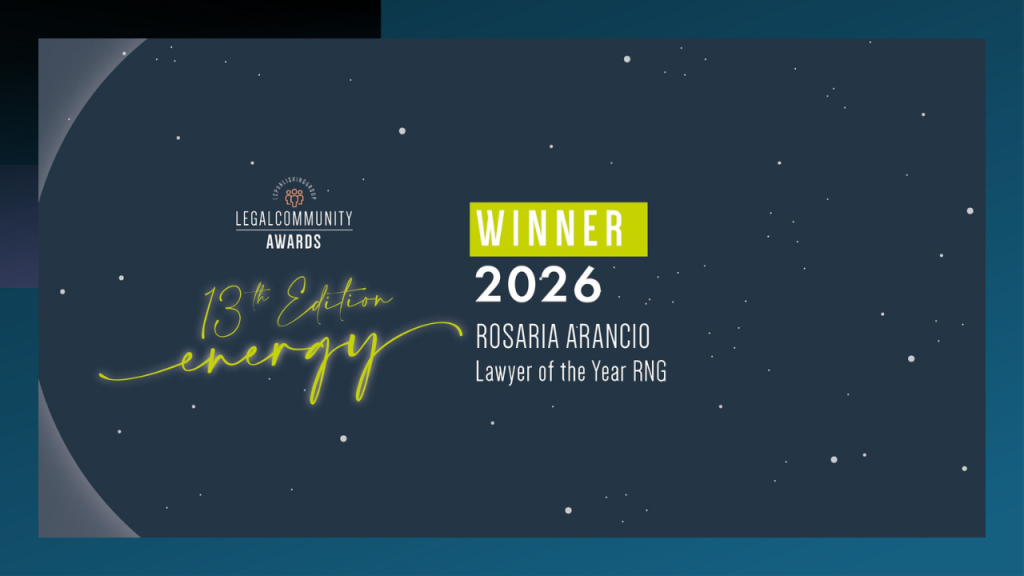
Rosaria Arancio, Winner of the “Lawyer of the Year RNG” Award at the Legalcommunity Energy Awards 2026
We are proud to announce that Rosaria Arancio, partner at GA-Alliance, is the winner of the Lawyer of the Year award in the RNG (Renewable Natural Gas) category at the prestigious Legalcommunity Energy Awards.
This recognition celebrates Rosaria’s deep and highly specialized expertise in the Energy sector, as well as her continued commitment to supporting the most dynamic operators in a field that plays a central role in the country’s economy. From administrative and regulatory advisory work to the management of complex litigation, her comprehensive 360-degree approach has proven decisive in a year marked by major challenges and transformation for the industry.
This award is not only an individual milestone but also reflects the dedication of the entire GA-Alliance team in supporting key players in the energy transition with outstanding legal solutions.
Congratulations to Rosaria on this well-deserved success!
With its judgement in the joined cases T-600/23 and T-612/23, published on the 1st of October 2025, the General Court annulled a decision of the Board of Appeal of the European Union Agency for the Cooperation of Energy Regulators (“ACER”) – which confirmed ACER’s decision on capacity calculation methodologies for electricity transmission in the ‘Core[GL1] ’ region and namely in Belgium, the Czech Republic, Germany, France, Croatia, Luxembourg, Hungary, the Netherlands, Austria, Poland, Romania, Slovenia, and Slovakia ( “Core region”).
Pursuant to the now repealed Regulation No 714/200[GA2] 9[1], the European Commission adopted Regulation (EU) 2015/1222[2], establishing guidelines on capacity allocation and congestion management in the electricity sector. This regulation sets out requirements for cross-zonal capacity allocation[3][GL3] and congestion management[4][GL4] in the day-ahead[5][GL5] and intraday markets[GL6][6], [GA7] including the definition of common methodologies for calculating the day-ahead and intraday cross-zonal capacity within different regions. Article 20, in particular, lays down the rules for the introduction of capacity calculation methodologies using a “flow-based approach”, which is defined as a “capacity calculation method in which energy exchanges between zones are limited by power transfer distribution factors (“PTDFs”) and available margins on critical network elements”[7]. The capacity calculation for the Core region applies this flow-based approach.
In accordance with Article 9(1) and Article 20(2) of Regulation 2015/1222, the Transmission System Operators (“TSOs”) of each capacity calculation region are required to develop proposals for capacity calculation methodologies and submit them to the relevant National Regulatory Authorities (“NRAs”) for approval. Pursuant to Article 9(10), (11) and (12), the NRAs concerned must try to reach an agreement and adopt a decision on the TSOs’ proposals. If no agreement can be reached, ACER is required to adopt a decision on the TSOs’ proposals or on a revised version thereof.
In the present case, after the NRAs failed to reach an agreement on the proposals submitted to them by the TSOs of the Core region, the matter was referred to ACER, which adopted modified versions of the regional design of the common capacity calculation methodologies through Decision No 02/2019 (“ACER First Decision”).
ACER First Decision was immediately appealed, on 23 April 2019, by Germany’s regulatory authority, Bundesnetzagentur für Elektrizität, Gas, Telekommunikation, Post und Eisenbahnen (“BNetzA”), before ACER’s Board of Appeal, as well as by the Federal Republic of Germany before the General Court on 2 May 2019.
On 11 July 2019, however, by Decision A-003-2019 (“ACER Appeal Decision”), [GL8] ACER’s Board of Appeal dismissed the appeal brought by BNetzA against the initial decision.
Despite this, BNetzA did not surrender and, on 21 September 2019, brought an action before the General Court seeking the partial annulment of ACER First Decision, as well as the annulment of ACER Appeal Decision. In 2022, the General Court annulled ACER Appeal Decision, stating that the Board of Appeal had failed to properly assess whether the approved methodologies complied with the requirements under the new Regulation (EU) 2019/943 on the internal electricity market, which had in the meantime been approved and repealed the previous Regulation No 714/2009[GA9][8]. Following the Court’s ruling, the Board of Appeal confirmed ACER’s initial decision, claiming that the methodologies were indeed in line with the applicable provisions of the new regulation.
In response, both BNetzA and the Federal Republic of Germany brought a new action[GL10] before the General Court, alleging an infringement of Articles 14 to 16 of Regulation 2019/943 and Article 29(3)(b) of Regulation 2015/1222, and seeking the partial annulment of the Board’s decision, specifically in relation to Articles 5(8)(b), 5(8)(c), and 5(9) of the methodologies. Indeed, these provisions imposed specific requirements on the TSOs of the Core region when proposing internal network elements and the relevant contingencies for capacity calculation, making it impossible – or at least more difficult – to apply capacity calculation to internal network elements. BNetzA and the Federal Republic of Germany essentially argued that nothing in the wording of the provisions of Regulations 2019/943 and 2015/1222 allows the inclusion of an internal network element – significantly influenced by cross-zonal exchanges – in the capacity calculation to be made conditional upon the performance of an economic efficiency analysis and of an impact assessment of increasing the threshold for inclusion.
According to the applicants, the Board’s interpretation was inconsistent with the literal and teleological interpretation of Articles 14 to 16 of Regulation 2019/943 and of Article 29(3)(b) of Regulation 2015/1222, from which it is clear that the capacity calculation must include all internal network elements (and the relevant contingencies) that are influenced by cross-zonal exchanges irrespective of whether or not those elements are structurally congested.
The General Court agreed, finding that ACER had overstepped its authority by introducing requirements not grounded in the applicable legal framework. Specifically, the Court found that the contested interpretation, indeed, infringed Articles 14 to 16 of Regulation 2019/943 and Article 29(3)(b) of Regulation 2015/1222, as they do not permit the introduction, into the methodologies at issue, of the requirements at issue, which impose obligations going beyond the mere communication of the list of internal critical network elements (CNEs) (and the relevant contingencies) meeting the PTDF criterion, as referred to in Article 5(8)(a) of those methodologies[9].
Accordingly, the Court, after joining cases T-600/23 and T-612/23, brought respectively by BNetzA and the Federal Republic of Germany, annulled Decision A-003-2019 of ACER’s Board of Appeal, in so far as it adopted Article 5(8)(b) and (c) and Article 5(9) of the regional design of the day-ahead and intraday common capacity calculation methodologies for the capacity calculation region comprising Belgium, the Czech Republic, Germany, France, Croatia, Luxembourg, Hungary, the Netherlands, Austria, Poland, Romania, Slovenia and Slovakia, as set out in ACER’s Decision No 02/2019.
Relevance of the case
The General Court’s annulment of Decision A-003-2019 of ACER’s Board of Appeal marks a significant clarification of the EU’s institutional framework and the limits of ACER’s powers.
This ruling is important for several reasons[GA11] :
Clarification of Regulatory Limits. The Court firmly established that ACER cannot impose additional obligations – such as economic efficiency analyses or impact assessments – that are not explicitly provided for in EU legislation. Specifically, it held that Articles 14 to 16 of Regulation (EU) 2019/943 and Article 29(3)(b) of Regulation (EU) 2015/1222 do not authorize the introduction of requirements that go beyond the mere submission of the list of internal critical network elements (CNEs) that are significantly influenced by cross-zonal exchanges.
Institutional Legitimacy and Legal Certainty. The ruling reinforces the principle of institutional balance by limiting ACER’s regulatory discretion. It confirms that EU agencies must operate strictly within the legal framework established by the legislature and cannot reinterpret or expand it in ways that affect the rights and responsibilities of Member States or national regulatory authorities.
Protection of National Competence in Market Design. The judgment safeguards the role of Member States and national regulators in shaping electricity market structures – particularly regarding structural congestion and bidding zone configurations – ensuring that EU agencies respect national prerogatives and do not overstep their mandate.
Strengthening the Rule of Law in Energy Regulation. By annulling the contested provisions of ACER’s methodologies, the Court emphasized the importance of strict adherence to the legal framework governing the internal electricity market. It also highlighted the need for a literal, contextual and purposive interpretation of EU regulations, ensuring that regulatory bodies act only within the scope of powers delegated to them.
Ultimately, the judgment reinforces the foundational principle that EU institutions must respect the limits of their delegated authority, thereby upholding legal certainty and the rule of law across the Union as enshrined in Article 2 of the Treaty on European Union[GA12] .
[1] Regulation (EC) No 714/2009 of the European Parliament and of the Council of 13 July 2009 on conditions for access to the network for cross-border exchanges in electricity and repealing Regulation (EC) No 1228/2003, Article 18(5). The full text of the Regulation is available at the following link. The referenced Regulation has been repealed by Regulation (EU) 2019/943 of the European Parliament and of the Council of 5 June 2019 on the internal market for electricity. The full text of the latter Regulation is available at the following link.
[2] Commission Regulation (EU) 2015/1222 of 24 July 2015 establishing a guideline on capacity allocation and congestion management. The full text of the latter Regulation is available at the following link.
[3] Cross-zonal capacity allocation refers to the process of determining and assigning the available transmission capacity between different bidding zones (countries or market areas) in the electricity market. It ensures that electricity can flow efficiently and securely across borders – for example, from a zone with surplus generation to a zone with higher demand – while preventing network congestion and maintaining system reliability.
[4] Congestion management refers to the set of rules, procedures, and actions used to prevent or relieve network congestion in electricity transmission systems. Congestion occurs when the physical limits of the transmission network prevent all desired electricity exchanges between market participants from being realized simultaneously. The goal of congestion management is to ensure efficient use of the transmission network, maintain system security, and facilitate fair and non-discriminatory access to cross-border capacity.
[5] Day-ahead market time-frame’ means the time-frame of the electricity market until the day-ahead market gate closure time, where, for each market time unit, products are traded the day prior to delivery. See for reference Article 2(34) of Regulation (EU) 2015/1222.
[6] Intraday market time-frame’ means the time-frame of the electricity market after intraday cross-zonal gate opening time and before intraday cross-zonal gate closure time, where for each market time unit, products are traded prior to the delivery of the traded products. See for reference Article 2(37) of Regulation (EU) 2015/1222.
[7] See for reference Article 2(9) of Regulation (EU) 2015/1222.
[GL1]Speghiamo in nota chi sono le Core region in nota
[GA2]Please provide the footnote with the link to the Regulation (as added now in track changes) along with the status of it (repealed( and cite the exact provision providing for the possibility of adopting guidelines.
[GA11]In the core points of the ruling that are exposed below, it is suggested that reference to the specific paragraphs of the ruling are referenced in footnotes or in brackets in the main text.
[GA12]Suggestion: here you could add a reference to the EU Treaties providing for the rule of law to highlight also the importance of the ruling.
News
Apr 28 2025
Consultation Opens for 2025 Nuclear Programme Update
The Commission has launched a 4-week call for evidence related to the investment needs of the nuclear power sector in the EU. Seen as an important part of the consultative process and an opportunity for input from stakeholders and the public, the feedback received through this exercise will feed into the Commission’s work in preparing the update of the Nuclear Illustrative Programme (PINC), which is foreseen for publication before the end of 2025. The period to provide feedback is opened until 12 May.
The key objective of the PINC update will be to provide an up-to-date comprehensive, fact-based overview of nuclear energy investments across the EU in line with decarbonisation targets and the REPowerEU and Clean Industrial Deal goals. By covering the full lifecycle of nuclear installations, the programme will identify investment trends, needs, and challenges in the sector, based on objectives pursued by EU countries.
PINC also seeks to stimulate action by stakeholders and facilitate coordinated development of their investments in nuclear energy. In particular, the updated PINC aims to
clarify relevant investment needs for both new-build projects and lifetime extensions of existing reactors
identify development and investment needs essential for responsible spent fuel and radioactive waste management and for a robust supply chain
provide an overview of innovative nuclear technologies (SMRs, fusion) currently under development in the EU and highlight opportunities and potential challenges associated with developing and deploying them
highlight needs associated with key enablers in the nuclear sector, including: (i) national regulatory capacity; (ii) transparency and public engagement; (iii) skills/ workforce gaps; and (iv) international collaboration
The proposed initiative will also seek to document and analyse several key challenges, including
the EU’s retention of its strategic leadership in the global nuclear sector
vulnerabilities in the EU supply chain
limited market uptake and slow commercialisation of innovative nuclear technologies
access to financing
attracting new talent and retraining the existing workforce
La Commissione Europea ha adottato un nuovo pacchetto di misure di semplificazione (c.d. “Omnibus I e II”) volto a rafforzare la competitività UE e liberare capacità di investimento aggiuntiva, riducendo gli oneri amministrativi di almeno il 25% e quelli per le PMI di almeno il 35%.
Si tratta di una semplificazione di vasta portata nei settori dell’informativa sulla finanza sostenibile, del dovere di diligenza ai fini della sostenibilità, della tassonomia dell’UE, del meccanismo di adeguamento del carbonio alle frontiere, dei programmi di investimento europei.
Più precisamente esso si articola in:
Una proposta di Direttiva che modifica la CSRD (Corporate Sustainability Reporting Directive) e la CSDDD (Corporate Sustainability Due Diligence Directive);
Una proposta (c.d. “Stop the clock”) che posticipa l’applicazione di tutti gli obblighi di rendicontazione previsti dalla CSRD per le imprese tenute a riportare nel 2026 e 2027 (le cosiddette imprese della seconda e terza wave), e che rinvia di un anno – al 2028 – sia il termine di recepimento sia la prima fase di applicazione della CSDDD;
Una bozza di atto delegato che modifica gli atti delegati sulla Tassonomia relativi alle informazioni da divulgare e ai criteri climatici e ambientali, attualmente sottoposta a consultazione pubblica;
Una proposta di Regolamento che modifica il Regolamento sul Meccanismo di Adeguamento del Carbonio alle Frontiere (C-BAM);
Una proposta di Regolamento che modifica il Regolamento InvestEU.
Modifiche agli obblighi di informativa della CSRD e della Tassonomia dell’UE
Concentrare gli obblighi di informativa sulle imprese di più grandi dimensioni e garantire che tali obblighi non si ripercuotano sulle imprese più piccole della catena del valore;
Posticipare di due anni (fino al 2028) gli obblighi di informativa per le imprese tenute a comunicare le informazioni a partire dal 2026 o dal 2027 (c.d. seconda e terza wave);
Ridurre l’onere degli obblighi di informativa relativa alla Tassonomia dell’UE e limitarlo alle imprese di maggiori dimensioni;
Introdurre una soglia di rilevanza finanziaria per la comunicazione in materia di Tassonomia e ridurre di circa il 70% i modelli da utilizzare;
Semplificare i criteri del DNSH più complessi per la prevenzione e la riduzione dell’inquinamento in relazione all’uso e alla presenza di sostanze chimiche;
Adeguare l’indicatore Green Asset Ratio (GAR): le banche potranno escludere dal denominatore del GAR le esposizioni relative a imprese che non rientrano nell’ambito di applicazione futuro della CSRD.
Semplificazione degli obblighi di dovuta diligenza della CSDDD
Concentrare gli obblighi di dovuta diligenza sui partner commerciali diretti (sono dunque esclusi quelli indiretti);
Portare da 1 a 5 anni la frequenza delle valutazioni periodiche e del monitoraggio dei partner commerciali;
Limitare la quantità di informazioni che possono essere richieste alle PMI da parte delle grandi imprese nell’ambito della mappatura della catene di valore;
Rinvio di un anno (26 luglio 2028) per le imprese obbligate ad adottare gli obblighi di dovuta diligenza entro il 2027, ossia le imprese con oltre 5.000 dipendenti e fatturato netto a livello mondiale superiore a 1.500.000.000 EUR nell’ultimo esercizio precedente al 26 luglio 2027;
Anticipare di un anno l’adozione delle linee guida (luglio 2026);
Modificare le condizioni di responsabilità civile dell’UE.
Semplificazione del meccanismo CBAM
Al fine di esentare i piccoli importatori dagli obblighi CBAM (per lo più PMI e persone fisiche), viene fissata una nuova soglia annua cumulativa CBAM pari a 50 tonnellate per importatore;
Generale semplificazione delle norme, comprese quelle relative al calcolo delle emissioni incorporate e gli obblighi di rendicontazione e rafforzamento delle norme contro le elusioni e gli abusi;
Estensione dell’ambito di applicazione del CBAM, in particolare alle merci a valle, attraverso una nuova proposta legislativa all’inizio del 2026.
Knowledge Management
Jan 30 2025
Energy - Last news from the EU
On 11 September 2024, the European Commission published the State of the Energy Union report which describes how the EU has managed unprecedented challenges in the energy policy landscape during this Commission's mandate, equipping the EU with a regulatory framework for pursuing the clean energy transition and laying the foundations for renewed economic growth and competitiveness.
Key legislative updates in the EU energy sector
The European Union has recently taken significant steps in its energy legislation to support its climate neutrality objectives for 2050 and emission reduction targets for 2030. The following legislative measures have been introduced or entered into force:
Renewable Energy Directive (RED): Enhancements to the RED focus on increasing the share of renewable energy sources, streamlining permitting processes, and integrating renewables into the EU energy grid
Energy Efficiency Directive (EED): Stricter requirements for energy consumption reduction across member states, promoting sustainable practices and efficient use of energy.
Energy Performance of Buildings Directive (EPBD): Mandates to improve energy efficiency in the building sector, with targets for new constructions and renovations.
Hydrogen and Decarbonised Gas Markets Package: Comprehensive regulations to facilitate the adoption of hydrogen and other low-carbon gases.
Methane Emissions Regulation: A groundbreaking regulation to monitor and reduce methane emissions in the energy sector.
Electricity Market Design Reform (in detail on pages 6-7): Aims to create a more resilient and consumer friendly energy market while ensuring security of supply.
Extension of the Emissions Trading System (ETS): Inclusion of new sectors and tightened caps to strengthen the EU’s carbon pricing mechanism.
Achievements in 2024:
Record Renewable Installations: In 2023, the EU installed 56 GW of new solar capacity, with renewables accounting for 50% of electricity generation in the first half of 2024.
Reduced Dependency on Russian Energy: Imports of Russian gas have fallen from 45% of total EU imports in 2021 to 18% by mid-2024. Similar reductions have been achieved for coal and oil imports.
Progress in Energy Security: Gas storage reached a record 90% capacity by mid-August 2024, ensuring resilience for winter energy demands.
Key Achievements Under the Fit-for-55 and REPowerEU Plans:
Energy Efficiency Gains: Primary energy consumption has declined, moving closer to the 2030 targets.
Decarbonisation Milestones: The EU’s greenhouse gas emissions are 32.5% lower than 1990 levels, and the Emissions Trading System (ETS) has expanded to include maritime transport.
Renewable Energy Expansion: Wind and solar energy installations have surged, with wind surpassing gas generation as the second largest electricity source after nuclear.
Diversification of Energy Imports: Norway and the U.S. have become the EU’s largest suppliers of pipeline and LNG gas, respectively, replacing Russian imports.
Support for Clean Energy Technologies: Initiatives like the European Solar PV Industry Alliance and the European Industrial Alliance on Small Modular Reactors (SMRs) have been launched to strengthen the clean energy sector.
Economic and Employment Benefits
Job Creation: REPowerEU targets are projected to create over 3.5 million jobs by 2030, emphasizing the economic opportunities in the energy transition.
Competitiveness: The Net-Zero Industry Act and Critical Raw Materials Act aim to ensure resilient supply chains and support for European manufacturers in the global clean energy market.
Challenges and Future Steps
Addressing Ambition Gaps: More robust measures are required to meet the 2030 renewable energy and efficiency targets.
Energy Poverty: Tackling high energy costs remains a priority, with targeted interventions to shield vulnerable populations.
Grid Modernization: The Grids Action Plan addresses challenges in expanding and digitalizing electricity infrastructure across the EU.
EU Initiatives to Watch
European Hydrogen Bank: Supporting hydrogen investments and market development with new auctions and funding mechanisms.
Aggregate EU Platform: A permanent tool for joint purchasing of natural gas and strategic commodities, enhancing energy security.
European Net-Zero Academies: Providing workforce training in renewable energy, hydrogen, and other key sectors.
Expansion of LNG Infrastructure: New terminals and expansion projects have increased the EU’s LNG import capacity, improving energy security.
European Renewable Energy Auctions Platform: A new platform to consolidate information on planned renewable energy auctions across the EU, streamlining investments in the sector.
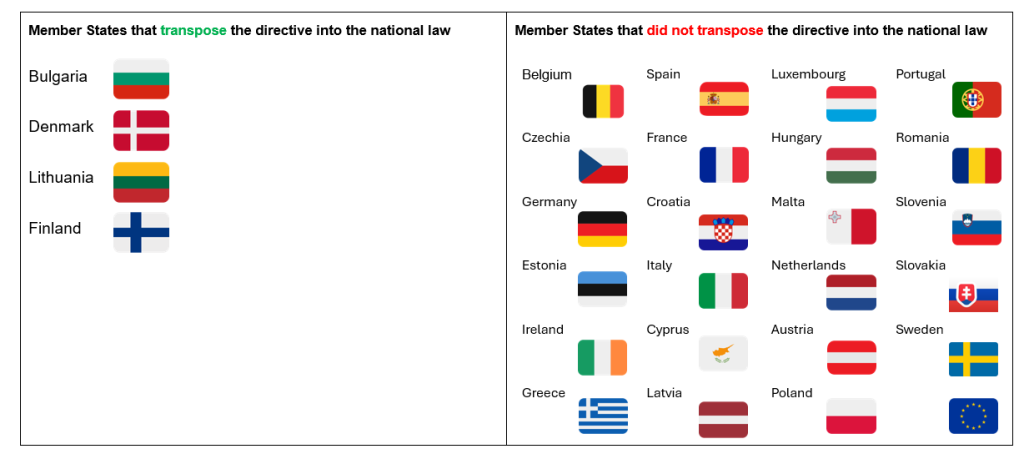
17 January was the deadline for EU member states to transpose the new electricity market design rules into national law. These rules have been created to tackle rising energy prices. They aim to make energy prices more stable and predictable for consumers and less dependent on the price of fossil fuels.
Member States were required to take national measures to:
Energy costs which are more reflective of (cheaper) renewable energy and also more predictable.
Wider choice of consumer contracts and clearer information before signing contracts.
Option to lock in secure, long-term prices.
Dynamic pricing contracts, if needed, to take advantage of price variability to use electricity when it is cheaper.
Protection from being without electricity through the establishment of suppliers of last resort.
Protection from disconnection for those who are vulnerable or energy poor.
More opportunities for energy sharing, for example, tenants will be able to share surplus rooftop solar power with a neighbour.
According to EUR-Lex, the vast majority of EU member states have failed to transpose the New Market Design Directive into national law.
On 23 January during the World economic forum in Davos a new Global Energy transition Forum was launched by European Commission President Ursula von der Leyen along with international partners with the objective of reaching for ambitious climate targets at world level and supporting countries for whom the clean transition is more challenging.
The forum aims to:
Maintain momentum on global energy agreements and integrate these targets into new Nationally Determined Contributions (NDCs) ahead of the COP.
Transform these targets into concrete projects that benefit people, such as bringing power to underserved communities and scaling up clean energy globally.
Unlock more investment through smart finance, de-risking tools, blended finance, and other creative solutions to attract private capital.
President von der Leyen highlighted the unprecedented levels of world spending on clean energy. “Last year alone, global spending on clean energy hit a record USD 2 trillion. For every dollar invested in fossil fuels, you had two dollars invested in renewable energy. In the power sector, clean energy investments outnumber fossil fuels ten to one. This is a shift we have been working towards for years,” she remarked.
Challenges: Despite progress, regions like Africa still struggle to benefit from the clean energy transition, receiving only 2% of clean energy investment despite having 60% of the world’s best solar resources.
Scaling Up Manufacturing: The forum also focuses on scaling up manufacturing to improve grids and storage capacity, requiring massive investment that no single company or country can undertake alone.
The President concluded saying: “I want to be very clear with my message: Europe stays the course and we stand ready to work with all global actors to accelerate the transition to clean energy.”
The European Commission has published a new study that provides an in-depth look at the state of net-zero technology manufacturing across the EU. The study highlights advancements in key sectors such as wind, solar, batteries, carbon capture, and heat pumps. It aims to fill data gaps and offer a reliable assessment of the manufacturing capacities for these technologies in all 27 EU countries.
Key findings include:
1. Manufacturing Capacity: A detailed mapping of the current manufacturing capabilities for net-zero technologies in each EU country.
2. Policies and Incentives: Analysis of the national policies and incentives that support the growth of manufacturing capacities. This includes regulatory frameworks, investment incentives, and skills development programs.
3. Challenges and Opportunities: Identification of bottlenecks in the manufacturing process and potential opportunities to increase production capacity.
The study also highlights best practices in policy frameworks and notes that nearly three-quarters of EU countries have introduced incentive programs to boost investments in net-zero technology manufacturing. At the EU level, the Net-Zero Industry Act aims to enhance manufacturing capacity by addressing barriers to scaling up production in Europe.
The European Commission recognizes the importance of involving young people in policymaking processes and ensuring they are well-informed and actively participating in the energy transition.
Youth Involvement: The European Commission aims to enhance youth participation in energy policy discussions, recognizing that 67% of young people see EU actions impacting their daily lives.
Employment and Skills: The renewable energy sector is growing, with significant job opportunities expected. By 2030, 3.5 million new jobs will be needed, particularly in wind and photovoltaic sectors.
Education and Awareness: The Commission is stepping up its efforts to provide information and tools for young people to get involved in the energy sector and to remove barriers such as lack of information and relevant curricula.
Young Energy Ambassadors: Launched in 2023, this program selects 30 young people annually to promote engagement and awareness about EU energy policies.
Educational Initiatives: The ‘Back to School’ initiative and e-learning content on the EU Academy website aim to educate students about energy, climate, and environment issues.
The Commission, the EU Agency for the Cooperation of Energy Regulators (ACER) and the Renewables Grid Initiative (RGI) have launched a survey on enhancing regulatory environments for stakeholder engagement in electricity infrastructure projects in the EU, under the EU’s Pact for Engagement. The survey will be open for 4 weeks, i.e. until 23 February 2025.
Purpose: To understand practices, opportunities, challenges, and enabling conditions related to regulatory and legal frameworks of stakeholder engagement.
Target Audience: Grid operators across Europe (TSOs and DSOs) and National Regulatory Authorities (NRAs).
Outcome: Results will contribute to enhanced regulatory environments and will be presented at the 11th Energy Infrastructure Forum in June 2025 and at the Pact for Engagement Stakeholder Meetings.