GA-Alliance

Antitrust & Competition

GA-Alliance

We provide professional assistance in European Union law, focusing on key areas relating to the free movement of goods, individuals, services and capital. Additionally, we cover European financing, public procurement, energy, transport, infrastructure, telecommunications and other practice areas.
Our team of lawyers provide expert guidance at all stages of proceedings before both national and European institutions – including litigation – such as European and national Courts.

Owing to the skills and professionalism we have acquired over time, we are the only Italian Firm serving as legal advisor to esteemed bodies such as the European Commission and the European Parliament, entrusted with drafting analyses and studies across diverse fields. In addition, our services extend comprehensively into all areas of competition law, including merger control between companies at national, EU and multi-jurisdictional level, procedures aimed at assessing anticompetitive agreements between companies and abuses of dominant position, unfair commercial practices, State aid and the provision of antitrust compliance programmes.

With highly qualified lawyers specializing in antitrust and competition law, we offer clients effective legal advice and tailor-made solutions to navigate the complexities of the global marketplace.

Our experts

VIEW MORE

Caricamento..

Insights

GA-Alliance

Knowledge Management

Jul 27 2026

EU Commission imposes interim measures on Meta

On June 9th, 2026, the EU Commission announced that it is imposing interim measures on Meta while the investigation on a possible abuse of dominance is carried out. The antitrust investigation, opened in December 2025, means to evaluate the legality of Meta’s revised policy which blocks access for AI providers, other than Meta AI, to WhatsApp.[1]

INDEX

FACTUAL BACKGROUND

Meta, formerly known as Facebook, acquired WhatsApp in 2014. The merger was given the greenlight by the EU Commission after an extensive study on possible anticompetitive effects in three different relevant markets: consumer communication services, social networking services, and online advertising. The assessment was based on information and promises shared by Facebook regarding the unlikelihood of automated matching between Facebook users’ accounts and WhatsApp users’ accounts following the merger. Nevertheless, in 2016, WhatsApp announced updates to its terms of service and privacy policy, including the possibility of linking WhatsApp users' phone numbers with Facebook users' identities.[2] The Commission reacted by fining Facebook €110 million for providing misleading information about the takeover after finding that, contrary to Facebook’s statements from 2014, its staff were aware of the possibility of matching the platforms’ accounts and identities.

Facebook infringed Regulation 1/2003 by intentionally or negligently providing the incorrect or misleading information to the Commission. The fine was meant to act as a deterrent proportional to the nature, gravity and duration of the infringement, after taking into consideration all mitigating and aggravating circumstances. It was the Commission’s first ever decision involving the imposition of fines on a company for providing incorrect or misleading information since the entry into force of the 2004 Merger Regulation. There were no other measures taken aside from the fine and the merger continued to set Facebook (now Meta) on the course toward achieving and maintaining a dominant position status. This is the status that proves problematic for the current event.

In October 2025, Meta announced that it would update its WhatsApp Business Terms, effectively banning third-party general purpose Artificial Intelligence (“AI”) assistants from the consumer communication application. The Commission has considered WhatsApp to hold a dominant position in the market since at least January 2023. Therefore, the update to the Terms is considered, at first sight, to be a possible abuse of dominant position, as competing general-purpose AI assistants are precluded from using the platform’s Business Application Programming Interface (“API”).

Starting mid-January 2026, the only AI assistant available on WhatsApp was Meta’s own AI tool (“Meta AI”). The complete exclusion of all competitors was lessened on March 4th, when a revision of the policy accepted third-party general-purpose AI assistants again on the platform, but levied an access fee which is being classified as a practice possibly equivalent to the previous access ban. Teresa Ribera, executive Vice-President of the Directorate-General for Competition, stated that the fees were so elevated that they could not be economically sustained by competitors.

Formal proceedings were opened by the Commission in December 2025. The decision to initiate antitrust proceedings covered the EEA except for Italy, as the Italian National Competition Authority (AGCM) imposed its own interim measures on Meta in December. Shortly after, a Statement of Objections was released, setting out the Commission’s preliminary view that Meta breached EU antitrust rules by excluding third party AI assistants from accessing and interacting with users on WhatsApp.[3] Meta's conduct risks blocking competitors from entering or expanding in the rapidly growing market for AI assistants.

April 2026 marked the expansion of the investigation to Italy, allowing the study to analyze conduct changes since the initiation of proceedings.

Meta’s response denounces the opening of the investigation as they find that the Commission’s approach imposes unfair conditions, allowing "OpenAI and some of the largest companies in the world [to] use the paid-for WhatsApp Business product for free," a Meta spokesperson said in an email.[4] An appeal will be filed by Meta as they find the investigation to be a “regulatory overreach subsidized by many European companies that pay.”

The substantive investigation into the merits of the case is still active and ongoing.

The investigation of case AT.40134 [CD1] is carried out through the lens of the antitrust laws set out in Article 102 TFEU and Article 54 of the EEA Agreement which prohibit the abuse of dominant positions that may affect trade and prevent or restrict competition within the Single Market.

The proceedings are carried out within the rules and limitations set out by Article 11(6) of Council Regulation No. 1/2003 (Cooperation between Commission and National Authorities)[5] and Article 2(1) of Commission Regulation No. 773/2004 (Initiation of Proceedings)[6].

Pursuant to Article 8(1) Regulation 1/2003, interim measures may be imposed in cases of urgency due to the risk of serious and irreparable damage to competition assessed on a basis of a prima facie finding of infringement. Although such measures are always imposed for a limited amount of time, they can be renewed until the end of the investigation (by June 2029 at the latest for the case at hand).

Meta faces a potential fine of up to 10% of its total turnover in the year preceding the alleged infringement if found to have breached the EU antitrust regulation and may also be subject to daily periodic penalty payments not exceeding 5% of the average daily turnover in the business year preceding the infringement if it does not comply without delay.

THE INTERIM MEASURE

The Commission has concluded that interim measures are warranted to prevent serious and irreparable damage to competition in the growing market for general-purpose AI assistants as Meta holds a dominant position in the market for consumer communication applications and is, at first sight, abusing this position by blocking access to the WhatsApp API. The refusal to provide access to an infrastructure developed for and previously open to third parties created an urgent need to prevent damage to the competition structure of the AI assistant market by stalling the growth of smaller players and new entrants that could possibly challenge large incumbents.

The decision orders Meta to re-instate access for third-party general purpose AI assistants to the platform’s Business API and to re-establish the same terms and conditions that were enforced before the policy change in October 2025, when access to the Programming Interface was free of charge. Those terms are meant to be enforced until the Commission adopts a final decision on the case. Compliance must be immediate, as Meta has five days to implement the measure.

Meta may also appeal the decision ordering the interim measures before the EU Courts pursuant to Section 17 of the Commission Antitrust Manual.

IMPORTANCE OF THE DECISION

Although Regulation No. 1/2003 expressly provides for the ability to impose interim measures if, at first sight, there is an infringement of competition law rules, this is only the second decision imposing such measures since 2019. The first and last instance of application of Art. 8(1) was in relation to the Broadcom case (AT.40608). Broadcom was found to have engaged in exclusionary practices and was subject to the first enforcement of interim measures implemented by the Commission. The interim measures decision, which had an implementation duration of three years, was shortly followed by a commitment decision (ex Art. 9 Regulation No. 1/2003) reflecting commitments offered by Broadcom and revised through a market test. Indeed, the commitment decision built on the applied interim measures, extending their effects for an additional seven years. Furthermore, the commitments covered additional areas of the market and more service providers who were in business with Broadcom.[7] Since then, the Commission has only once announced the possible use of interim measures in an investigation on potential competition restrictions on Lufthansa transatlantic routes to and from several airports in the EEA area[8], but it ultimately decided to abandon its request.

We may conclude that interim measures and commitment decisions are connected, as the former appear to suspend problematic behaviors and create incentives for the company under investigation to quickly find a lasting solution to the identified concerns. A commitment decision may also result in the Commission closing the investigation and simply monitoring the status, implementation, and results of said commitments.[9] Although the Commission may, upon request or of its own initiative, reopen the proceedings (e.g. if the undertaking concern acts contrary to their commitments), the prospect of closing the investigation early is a favourable one for the undertakings concerned. No reasonable economic agent wishes to remain involved in an investigation that can span years, under constant hawk-eye monitoring, and possible heavy fines and remedies.

It seems opportune to now start keeping an eye on other future uses of interim measures by the Commission as a tool to push undertakings to step back in line promptly in a way that spares time, money, and other resources that would otherwise be spent on a lengthy investigation. The transition from the monitoring of the implementation of interim measures to the monitoring of commitments is natural and efficient and it is something we are likely to see more of in future antitrust and competition regulation enforcement.


[1] Commission imposes interim measures on Meta to preserve free access to WhatsApp for rival AI assistants. European Commission Press Release, 9 June 2026. Commission imposes interim measures on Meta

[2] Commission Fines Facebook €110 million for providing misleading information about WhatsApp takeover, 18 May 2017. IP_17_1369_EN.pdf

[3] Commission Statement of Objections (Meta), 9 February 2026. AT_41034_606.pdf

[4] EU orders Meta to open WhatsApp to rival AI chatbots, BBC, Tom Singleton, 9 June 2026. EU orders Meta to open WhatsApp to rival AI chatbots

[5] Council Regulation (EC) No 1/2003 of 16 December 2002 on the implementation of the rules on competition laid down in Articles 81 and 82 of the Treaty. http://data.europa.eu/eli/reg/2003/1/2009-07-01

[6] Commission Regulation (EC) No 773/2004 of 7 April 2004 relating to the conduct of proceedings by the Commission pursuant to Articles 81 and 82 of the EC Treaty.  http://data.europa.eu/eli/reg/2004/773/2015-08-06

[7] Ex post evaluation of the implementation and effectiveness of EU antitrust remedies GA-Alliance Report 2025

[8] Case AT.40940 Press Release on Supplementary Statement of Objections to Lufthansa to prevent harm to Frankfurt-New York air passengers, 15 January 2025. Press Release

[9] A First in 20 Years: EU Commission imposes interim measures on Broadcom - Lexology


 [CD1]Exclusion of AI competitors from WhatsApp within the meaning of Article 11(6) of Council Regulation No 1/2003 and Article 2(1) of Commission Regulation No 773/2004

GA-Alliance

Knowledge Management

Feb 12 2026

Judgment of the Court of Justice in Case C‑588/24 — Imballaggi Piemontesi S.r.l. v. Autorità Garante della Concorrenza e del Mercato (AGCM)

By judgment delivered on 15 January 2026, the Court of Justice of the European Union ruled on a preliminary reference made by the Consiglio di Stato by order of 26 August 2024.

The referring court asked, in essence, whether Articles 41 and 47 of the Charter of Fundamental Rights of the European Union and Article 6 of the European Convention on Human Rights preclude a national regime which, in proceedings concerning the supervision of agreements restricting competition and for the purpose of exercising sanctioning powers (without prejudice to remedial powers), does not expressly treat the deadline for the conclusion of the procedure set out in the statement of objections as peremptory, thereby permitting the competition authority to unilaterally extend that deadline by reasoned acts where circumstances arise that lead to an objective or subjective enlargement of the scope of the investigation.

The question arose in the context of proceedings between Imballaggi Piemontesi S.r.l. (“Imballaggi Piemontesi”) and the Autorità Garante della Concorrenza e del Mercato (“AGCM”) concerning fines imposed for participation in the corrugated‑board cartel. By decision of 22 March 2017 the AGCM opened an investigation under Article 14 of Law No. 287/1990 and fixed the deadline for its conclusion at 31 May 2018. During the investigation the Authority extended the scope of the procedure both in terms of parties involved and in terms of the conduct under scrutiny, and accordingly postponed the deadline first to 31 December 2018 and subsequently to 19 July 2019. By decision No. 27849 of 17 July 2019 the AGCM found that Imballaggi Piemontesi had participated in an anti‑competitive agreement in the market for corrugated board sheets (the so‑called “sheets agreement”) and imposed a fine of €6,147,746. The Lazio Regional Administrative Court dismissed the company’s challenge, while the Consiglio di Stato upheld the appeal only as to the amount of the fine. Imballaggi Piemontesi brought an action for review (revocazione), alleging that the sanctioning measure was time‑barred because the investigative deadline had been breached, disputing the characterization of that deadline as merely directory rather than peremptory, and requesting that the Consiglio di Stato refer a question to the Court of Justice on the peremptory nature of the investigative deadline set by the AGCM in the act opening the procedure pursuant to Article 6(3) of Presidential Decree No. 217/1998.

The Court of Justice held that national competition authorities “must be able, where necessary in order to be able to impose effective and dissuasive fines for infringements of Union competition law, to defer the deadline for the conclusion of the investigative phase of that procedure.” In that regard, the Court reiterated that national competition authorities must be able to assign different priorities to the complaints submitted to them and therefore enjoy a wide margin of discretion. Consequently, an authority may be obliged to defer the investigative deadline, for example to give priority to other proceedings. The Court further observed that cases under Union competition law frequently require complex factual and economic analysis and that national authorities will often need to adopt numerous investigative acts and measures, which will inevitably extend the duration of the infringement procedure. The Court emphasised that an absolute prohibition on deferring the investigative deadline could impede the imposition of effective and dissuasive fines for infringements of Union competition law and could render the application of the relevant rules practically impossible or excessively difficult, in breach of the principle of effectiveness. Accordingly, the Court confirmed that national competition authorities may defer the investigative deadline where necessary for the imposition of sanctions.

The Court qualified that such a deferral must not result in the exceeding of a reasonable time within which the procedure must be concluded; that assessment is to be made in light of the circumstances of each case, including the complexity of the procedure and the conduct of the parties. The Court specified that any deferral:

  • must be duly reasoned by the national authority;
  • must be communicated as soon as possible to the undertaking concerned;
  • must be subject to judicial review.

Finally, the Court recalled that a breach of the principle of respect for a reasonable time may justify annulment of a decision only where it entails an infringement of the defence rights of the undertaking concerned. As the Consiglio di Stato had already found, Imballaggi Piemontesi did not demonstrate that the deferral of the investigative deadline prejudiced the exercise of its defence rights in the present case.

On that basis the Court concluded that Article 101 TFEU, read in the light of the general principle of the right to good administration, Article 47 of the Charter and the principle of effectiveness, must be interpreted as not precluding a national rule which does not expressly provide that the investigative deadline fixed in the statement of objections is peremptory, so that the national competition authority may unilaterally defer that deadline by reasoned acts subject to judicial review where circumstances arise that enlarge the subject‑matter of the procedure or the number of undertakings involved, provided that such deferral does not result in exceeding a reasonable time for the conclusion of the investigative phase.

*Reference: Judgment C‑588/24, para. 62.

GA-Alliance

News

Lahore, Jan 30 2026

GA-Alliance lands in Pakistan
Press release

GA-Alliance lands in Pakistan: strategic partnership signed with Axis Law Chambers

MILAN – 29 January 2026

GA-Alliance, a global legal and tax firm with more than 2,600 professionals in 80 countries, announces its entry into the Pakistani market. The strategic partnership with Axis Law Chambers, a leading full‑service law firm in the region, marks a further expansion of GA‑Alliance’s network, which today covers geographies that generate nearly 90% of global GDP.

The agreement strengthens GA‑Alliance’s commitment to its “one‑stop‑shop” strategy. By integrating local expertise with the highest global standards, the Alliance offers clients a single, efficient access point for all legal and tax needs. This model removes the complexities of managing multiple advisers across different jurisdictions, delivering a coordinated and seamless experience that prioritizes clarity and business growth.

Axis Law Chambers brings to the Alliance a reputation for excellence, particularly in high‑value cross‑border mandates and advice on complex regulatory matters. Regularly listed by Chambers and Partners and The Legal 500, Axis Law stands out for its transactional work in corporate matters, mergers and acquisitions (M&A), employment law, intellectual property, foreign investment, public‑private partnerships, corporate governance, antitrust, tax, data protection and sectoral compliance. The firm advises clients in key industries such as energy, oil & gas, mining, healthcare, telecommunications, automotive, financial services, defense, retail, manufacturing, agriculture, media, IT, logistics, real estate and non‑profit organizations.

Axis Law also boasts one of Pakistan’s most authoritative dispute resolution practices, including litigation and international arbitration, with solid experience in proceedings before ICSID (International Centre for Settlement of Investment Disputes, based in Washington, D.C., and part of the World Bank), ICC (International Chamber of Commerce, based in Paris) and LCIA (London Court of International Arbitration, based in London). This depth of expertise ensures GA‑Alliance clients receive top‑level support in the world’s fifth most populous country, one of the most dynamic economies in Asia.

Francesco Sciaudone, Managing Partner of GA‑Alliance, emphasized the strategic importance of the operation: “Our entry into Pakistan through the partnership with Axis Law Chambers is another step that strengthens our global growth path. At GA‑Alliance, the goal is to simplify complexity for our clients. By extending our ‘one‑stop‑shop’ model to an outstanding Pakistani firm, we are increasingly able to offer our clients the ability to operate with confidence in a very large number of markets worldwide. We are not only expanding our geographic presence; we are enhancing a sophisticated ecosystem where international best practices and precision meet local market leadership to meet clients’ needs in a simple, direct and highly efficient way.”


About GA‑Alliance

With more than 2,600 professionals in 80 countries, GA‑Alliance is a global legal and tax firm with deep European roots, combining a strong legal tradition with a broad international presence. Founded on principles of excellence and innovation, GA‑Alliance offers integrated, multidisciplinary expertise and positions itself as a strategic partner to promote sustainable growth in an ever‑evolving regulatory environment.


About Axis Law Chambers

Axis Law Chambers is a leading Pakistani law firm recognized for excellence in corporate and transactional advice and in resolving commercial disputes. With a team of over 30 professionals and seven partners, the firm assists national and multinational clients in high‑impact transactions, regulatory compliance and complex dispute resolution matters, including international arbitrations.

GA-Alliance

Eventi

Jan 22 2026

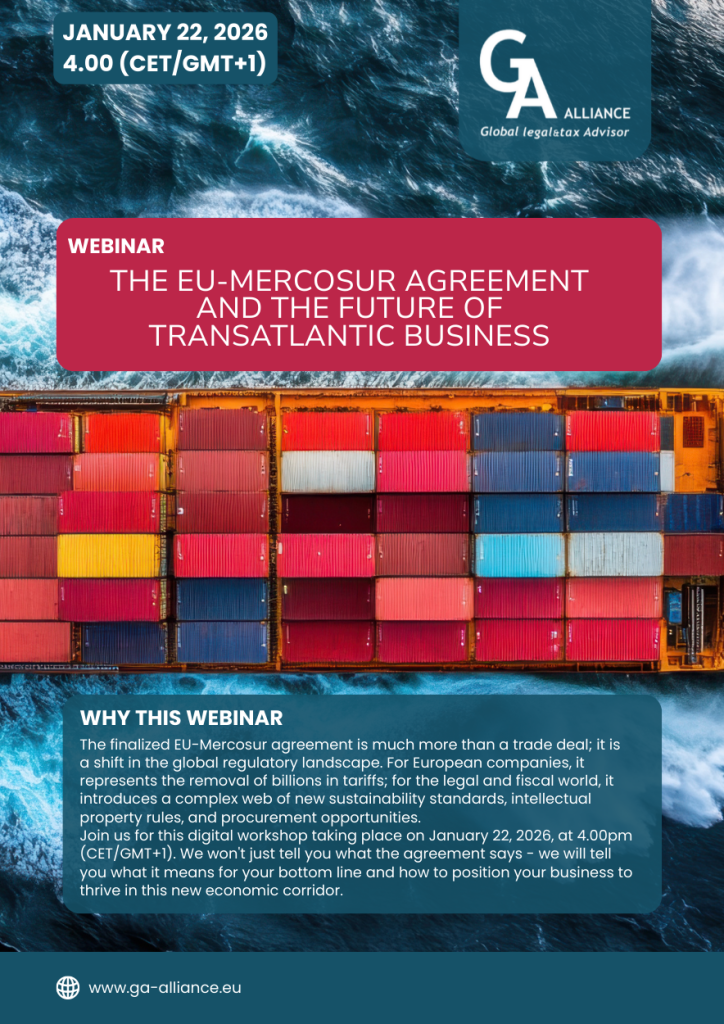
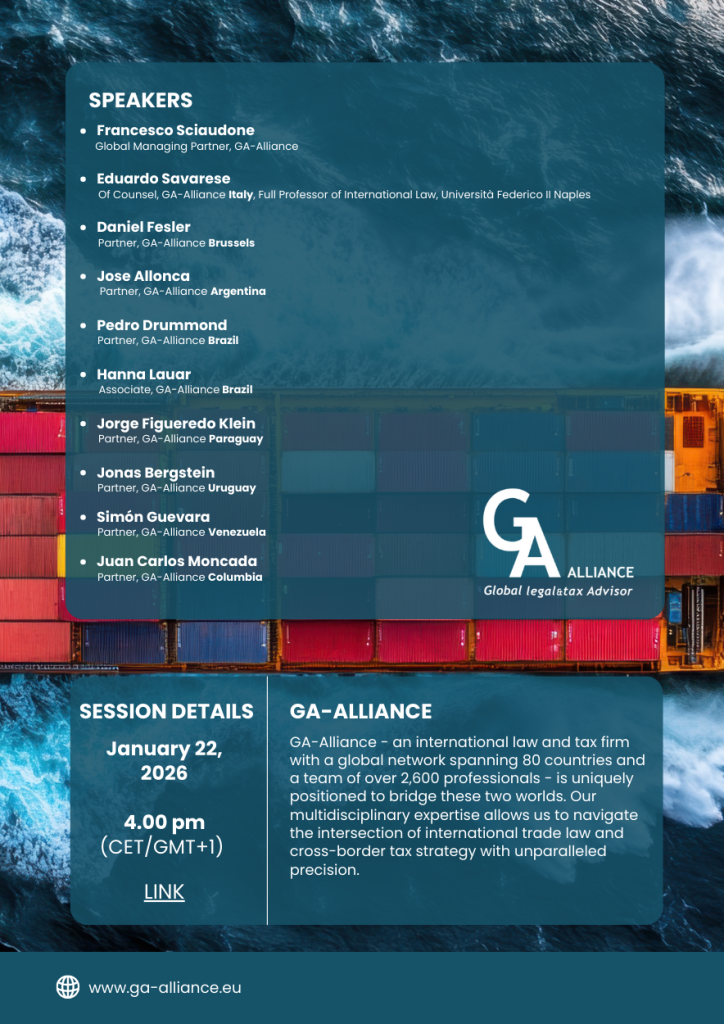
The EU-Mercosur agreement and the future of transatlantic business

Online Webinar by GA-Alliance

Online Webinar Event

The finalized EU-Mercosur agreement is much more than a trade deal; it is a shift in the global regulatory landscape. For European companies, it represents the removal of billions in tariffs; for the legal and fiscal world, it introduces a complex web of new sustainability standards, intellectual property rules, and procurement opportunities.

Join us for this online workshop taking place on January 22, 2026, at 4.00pm (CET/GMT+1). We won't just tell you what the agreement says - we will tell you what it means for your bottom line and how to position your business to thrive in this new economic corridor.


About GA-Alliance

GA-Alliance - an international law and tax firm with a global network spanning 80 countries and a team of over 2,600 professionals - is uniquely positioned to bridge these two worlds. Our multidisciplinary expertise allows us to navigate the intersection of international trade law and cross-border tax strategy with unparalleled precision.

Find us in the LATAM Area:

GA-Alliance

Knowledge Management

Jun 26 2024

EU Alert - Competition Law and State Aid

This newsletter provides a selection of opinions and analysis from our EU legal experts on interesting policy developments, recent case law and new regulatory directions of major industry practices. It is released biweekly and covers areas such as: Competition Law, Sanctions, Trade, Energy, Finance, EU funds, Data IP and Privacy, Life Sciences, Transport and Court of Justice of the European Union news.

The aim is to provide an up–to–date tool for quick and easy consultation on the most current and important topics at EU level.

The European Commission sends preliminary findings to Apple and opens additional non-compliance investigation against Apple under the Digital Markets Act (24.06.2024) The European Commission has informed Apple of its preliminary view that its App Store rules are in breach of the Digital Markets Act (DMA), as they prevent app developers from freely steering consumers to alternative channels for offers and content. In addition, the Commission opened a new non-compliance procedure against Apple over concerns that its new contractual requirements for third-party app developers and app stores, including Apple's new “Core Technology Fee”, fall short of ensuring effective compliance with Apple's obligations under the DMA. If the Commission's preliminary views were to be ultimately confirmed, none of Apple's three sets of business terms would comply with Article 5(4) of the DMA, which requires gatekeepers to allow app developers to steer consumers to offers outside the gatekeepers' app stores, free of charge. The Commission would then adopt a non-compliance decision within 12 months from the opening of proceedings on 25th March 2024.

Germany: the European Commission approves 3 billion euro German State aid scheme to support the development of Hydrogen Core Network (21.06.2024) The European Commission has approved, under EU State aid rules, an estimated 3 billion euro German scheme to support the construction of the Hydrogen Core Network (‘HCN'). The measure will contribute to the achievement of the objectives of the EU Hydrogen Strategy and 'Fit for 55' package, by enabling the creation of hydrogen transmission infrastructure that is needed to foster the use of renewable hydrogen in industry and transport by 2030. The measure aims to facilitate investments in the construction of the HCN. Necessary investments include (i) repurposing of existing gas pipelines to transport hydrogen, and (ii) building new hydrogen pipelines and compressor stations. The construction and operation of the HCN will be financed by hydrogen transmission system operators (TSOs), who will be selected by the German federal network agency, Bundesnetzagentur. The aid will take the form of a State guarantee which will allow the TSOs to obtain more favourable loans to cover initial losses in the ramp-up phase of the HCN. At first, Germany expects only a small number of consumers to be using the network, and the tariffs will be lower than otherwise needed to cover relevant costs, to encourage this use and facilitate the uptake of hydrogen.

The European Commission carries out further unannounced antitrust inspections in tyres sector cartel investigation (18.06.2024) – The European Commission is carrying out unannounced inspections at the premises of a consultancy firm in two Member States. Inspections are conducted in the context of an investigation for which the Commission carried out inspections earlier in 2024, that saw as products concerned by the inspections new replacement tyres for passenger cars, vans, trucks and busses sold in the European Economic Area. The European Commission is concerned that price coordination took place amongst the inspected companies, including via public communications. In particular the European Commission is concerned that the consultancy firm may have facilitated or instigated the suspected price coordination amongst tyre manufacturers, which allegedly also used public communications channels to collude.

Italy: the European Commission approves 570 million euro Italian State aid scheme to reduce emissions in ports (17.06.2024) – The European Commission has approved, under EU State aid rules, a 570 million euro Italian scheme to incentivize ships to use shore-side electricity when they are at berth in maritime ports. The measure contributes to reducing greenhouse gas emissions, air pollution and noise in line with the objectives of the European Green Deal. Under the scheme, the aid takes the form of a reduction of up to 100% of the so-called ‘general system charges'. Those charges are included in the electricity price and aimed at financing certain public policy objectives, including renewable energy. The reduction will result in a lower electricity price for ship operators when purchasing shore-side electricity and will bring the cost of electricity at a competitive level with the cost of producing electricity on-board through fossil-fueled engines. By lowering the cost of shore-side electricity for ships, the measure will incentivize ship operators to opt for the more environmentally friendly electricity supply, thereby avoiding significant greenhouse gas emissions, air pollutants and noise emissions.

Germany: the European Commission opens in-depth State aid investigation into measures to support local bus transport operator WestVerkehr (13.06.2024) – The European Commission has opened an in-depth investigation to assess whether certain support measures to German local public transport company WestVerkehr GmbH (‘WestVerkehr') are in line with EU State aid rules. The alleged aid measures are: (i) a direct award of a public service contract by the district of Heinsberg to WestVerkehr; (ii) a profit and loss transfer agreement between WestVerkehr and its majority shareholder NEW Kommunalholding GmbH; (iii) a payment into WestVerkehr's capital reserve by its minority shareholder Kreiswerke Heinsberg GmbH; and (iv) a current account agreement between WestVerkehr and Kreiswerke Heinsberg. NEW Kommunalholding and Kreiswerke Heinsberg are companies in which the district of Heinsberg holds shares. The Commission takes the preliminary view that these four measures constitute State aid.

The European Commission sends Statement of Objections to Alchem over first pharmaceutical cartel case in the EU (13.06.2024) – The European Commission has informed Alchem International Pvt. Ltd. and its subsidiary Alchem International (H.K.) Limited (together ‘Alchem') of its preliminary view that they have breached EU antitrust rules by participating in a long-lasting cartel concerning an important pharmaceutical product. If the Commission's preliminary view were confirmed, such behaviour would violate EU rules that prohibit anti-competitive business practices such as collusion on prices and market sharing. The sending of a Statement of Objections does not prejudge the outcome of the investigation.

Czech Republic: the European Commission calls for improvement of competition in organising waste collection and recovery in the packaging sector (11.06.2024) – The European Commission has informed Czechia that measures appointing EKO-KOM as the only company authorised for the collection and recovery of packaging waste for over two decades may be in breach of the EU competition rules. The Commission's preliminary view is that certain provisions of the Czech Packaging Act as well as Czechia's enforcement of such rules may have created significant entry barriers for rival companies. Such barriers include authorisation requirements that are very difficult to meet, such as strict contractual and financial conditions. The European Commission has voiced its competition concerns in the form of a Letter of Formal Notice. If the Commission's preliminary view is confirmed, this conduct would infringe Article 106 of the Treaty on the Functioning of the European Union (‘TFEU') in conjunction with Article 102 TFEU.

Hungary: the European Commission finds support for new auto parts plant in Észak Magyarország to be incompatible State aid (11.06.2024) – The European Commission has concluded that Hungary's plan to support the construction of a new automotive components plant in Észak Magyarország is not in line with EU State aid rules. Therefore, the aid cannot be granted by Hungary. Indeed. the available evidence showed that the beneficiary had decided to invest in Hungary without considering the public support and there was no sufficient evidence that the investment would take place in another location. Since the public support did therefore not have a real "incentive effect" and it did not effectively encourage GKN Automotive Hungary to invest in the specific region of Észak Magyarország, the aid is incompatible with EU State Aid rules. Therefore, the aid cannot be granted by Hungary.

GA-Alliance

Knowledge Management

Oct 25 2023

AI Update

Politico: Belgium pitches EU agency to screen algorithms

Image

Belgium thinks the European Union needs an agency with technical expertise in algorithms — and it will push for one during its stint at the Council presidency next year. 

More info

  EURACTIV: Cyber Resilience Act’s positions

Image

Both COREPER and the European Parliament’s Industry Committee adopted their positions on the Cyber Resilience Act. The negotiations between the EU co-legislators are due to start in September. 

More info

AI TRILOGUE

Image
The first political trilogue on the AI Act of the Spanish presidency reached little progress on the issues that were not already virtually closed at the technical level, media reports. 

More info

READ: Bruegel analysis of the AI Act

Image
J. Scott Marcus, a Senior Fellow at Bruegel writes that the European Union’s draft AI Act already needs to be revised to account for the opportunities and harms of generative AI. 

More info

EVETS: Stanford University

Image
Stanford HAI convened experts in artificial intelligence, law, and policy to explore the finer points of the regulation, what aspects may still be up for negotiation between the three EU institutions, what’s missing, and how likely technology companies will be able to follow it.  

More info

Keep in touch!

Sign up for our newsletters!

Stay up-to-date on domestic and international legislative and tax news
and international, as well as all the Firm’s events and initiatives.

Back
to top