GA-Alliance

Capital Markets

GA-Alliance

As a leading player in Capital Markets transactions, we provide unparalleled expertise to a wide range of clients, including financial institutions, investors, bond issuers and companies in debt issuance and regulated market listings.
Our services include:

Debt Issuance
We facilitate debt issuance transactions for both financial institutions and corporates across a broad spectrum of instruments, which include plain vanilla, structured, covered bonds, medium-term notes, euro bonds, domestic bonds, high yield bonds, hybrid bonds and project bonds, EMTN programmes and private placements. Leveraging our deep-seated expertise and industry experience, we provide strategic guidance to ensure that these transactions are executed seamlessly and in compliance with regulations.

Listings on Regulated Markets
We specialise in the listing of companies on regulated markets, both domestically and internationally. In particular, we hold a market-leading position in facilitating listings on the Euronext Growth Milan market, offering our clients a high quality service and personalised advice to ensure a smooth and successful transition to the market.

Backed by a team of experienced professionals dedicated to Capital Markets activities, we bring forth a wealth of qualifications and extensive industry knowledge. From inception to completion, we stand ready to support our clients at every stage of their capital market transactions, delivering outstanding results while ensuring compliance with regulatory standards.

Our experts

VIEW MORE

Caricamento..

Insights

GA-Alliance

Knowledge Management

Bruxelles, Jun 04 2026

EU-MERCOSUR: STRATEGIC OPPORTUNITIES AND PRACTICAL IMPLICATIONS FOR ITALIAN BUSINESSES


EU-MERCOSUR: STRATEGIC OPPORTUNITIES AND PRACTICAL
IMPLICATIONS FOR ITALIAN BUSINESSES

Key takeaways from the DG TRADE Italian Edition discussion – 26 May 2026

INDEX

Executive Summary

The DG TRADE Italian Edition discussion on 26 May 2026 provided a practical overview of what the EU-Mercosur Agreement could mean for Italian businesses, placing the debate within a broader geopolitical and commercial context. The discussion made clear that the agreement is being framed not only as a trade instrument, but also as a strategic response to Europe’s declining competitive position in parts of Latin America, particularly in comparison with China’s growing economic footprint in the region.

A central message from the speakers was that the agreement would create opportunities for European exporters by reducing both tariffs and administrative barriers, while preserving EU regulatory standards. For Italian businesses, this could translate into stronger market access, improved protection for geographical indications, and a more predictable commercial environment in sectors where Italy has established strengths. At the same time, concerns around sensitive agricultural imports were directly addressed, with assurances that EU food safety requirements and market safeguard mechanisms remain fully in place.

Market Access, Competitiveness and Regulatory Simplification

Much of the discussion focused on the practical implications of the agreement for European companies seeking to expand in Mercosur markets. Speakers emphasized that the commercial value of the agreement goes well beyond tariff reductions. A major advantage lies in the reduction of non-tariff barriers that often make exporting costly and slow, including duplicative technical checks, burdensome certification procedures, and import authorization processes that create uncertainty for businesses.

The agreement was also presented as a strategic tool to strengthen Europe’s competitive position in Latin America at a time when Chinese firms have become increasingly embedded in the region. According to the speakers, European businesses currently face a structural disadvantage in markets such as Brazil and Argentina, where China has consolidated its presence while European market share has weakened. Because China does not currently benefit from an equivalent trade arrangement with Mercosur, the agreement could improve the relative position of European exporters, particularly in sectors such as automotive manufacturing, fashion, wine, and industrial goods where Italian companies are especially active.

Sector-Specific Implications and Strategic Considerations for Italy

A more technical part of the discussion focused on rules of origin, which will determine whether products qualify for preferential tariff treatment. Speakers acknowledged that these requirements can be complex and differ significantly depending on the sector, especially where supply chains rely on components sourced globally. This means that businesses will need to assess carefully whether their products can effectively benefit from the agreement in practice.
For Italy, the agreement was presented as especially relevant for industries that rely on quality, brand value, and product authenticity. The protection of geographical indications was highlighted as a concrete gain, with products such as Parmigiano Reggiano expected to benefit from stronger recognition and protection in Mercosur markets. Agricultural sensitivities were also openly discussed, particularly concerning beef imports, with the Commission underlining that monitoring tools and safeguard measures are intended to mitigate risks for vulnerable European sectors. The discussion also briefly addressed Mercosur’s evolving political composition, including Bolivia’s prospective accession and Venezuela’s continued suspension, both of which may shape future developments.

Conclusions

The discussion framed the EU-Mercosur Agreement as a strategic attempt to combine economic opportunity with geopolitical positioning, offering new openings for European businesses while seeking to preserve the regulatory safeguards and market protections that remain central to the EU’s trade approach:

    • The EU-Mercosur Agreement is being positioned as both a commercial opportunity and a strategic instrument to strengthen Europe’s presence in Latin America.

    • For Italian businesses, the most immediate potential benefits lie in improved market access, reduced administrative barriers, and stronger protection for high-value branded products.

    • Real commercial gains will depend on companies’ ability to navigate technical implementation issues, particularly rules of origin and product-specific compliance requirements.

    • While sensitivities remain in agriculture, the Commission’s message was that regulatory protections and monitoring mechanisms are designed to ensure that market opening does not come at the expense of EU standards or vulnerable sectors.

GA-Alliance

Events

Rome, Feb 27 2026

Basket Bond Regione Lazio — our workshop in Rome

The workshop “Basket Bond Regione Lazio: Beyond Traditional Credit”, hosted last week at GA‑Alliance’s Rome office, turned discussion into a practical roadmap for local SMEs. Technical presentations, real‑world case studies and a roundtable with institutional representatives and market participants demonstrated how the Basket Bond can become a tangible instrument to finance growth, internationalisation and financial consolidation.

Why the Basket Bond matters for SMEs

  • Access to long‑term capital — The Basket Bond enables companies to secure financing with longer maturities than traditional bank loans.
  • Diversification of funding sources — Collective issuances allow SMEs to reduce reliance on bank credit and attract institutional investors.
  • Strengthening governance and reputation — Participation in an issuance requires transparency and standardisation, which improve corporate governance and market perception.

How it works in practice

  • Securitisation and public guarantee — Technical sessions explained how securitisation converts receivables into tradable securities and how public guarantees mitigate risk, making the securities more attractive to institutional investors.
  • Stable returns and mitigated risk — The combination of structure, rating and guarantees delivers a risk/return profile aligned with professional investors’ requirements.
  • Practical examples — Case studies illustrated pricing, maturities and placement mechanisms.

The operational role of arrangers

  • Key arrangers — CDP, Mediocredito Centrale, Banca Finint and Banca Finnat Euramerica outlined the essential operational steps: structuring the issuance, setting pricing, market placement and post‑issuance management.
  • Arrangers’ added value — Their experience is crucial to translate corporate needs into effective financial solutions and to secure market success.

Testimonials and value for companies

  • Support for growth plans — Participant testimonies highlighted how the Basket Bond model can finance productive investments and international expansion projects.
  • Operational Q&A — Questions from attendees clarified practical aspects for SMEs: eligibility requirements, impact on financial structure and implementation timelines.

GA‑Alliance’s role as Legal & Tax Advisor

Francesco Sciaudone, Managing Partner of GA‑Alliance, described the legal role of arrangers and the firm’s contribution in supporting issuances. With experience in approximately 200 issuances, GA‑Alliance emphasised the importance of specialised legal support to manage contractual complexity, compliance and relationships with institutional investors.

Roundtable speakers and principal contributors

  • Francesco Sciaudone — Managing Partner, GA‑Alliance
  • Roberta Angelìlli — Vice President, Regione Lazio
  • Giulio Bastia — Co‑General Manager, Banca Finnat Euramerica
  • Giuseppe Biazzo — President, Unindustria Roma – Frosinone – Latina – Rieti – Viterbo
  • Angelo Camilli — Vice President Credit, Finance and Tax, Confindustria
  • Vincenzo Paolo Carbonara — Head of Alternative Finance, CDP
  • Toni Ciolfi — Councillor, Ordine dei Commercialisti di Roma
  • Lorenzo Coletta — Head of Minibond and Basket Bond, Mediocredito Centrale
  • Massimo Fabiano — Head of Business Development Corporate Debt, Banca Finint
  • Andrea Martina — Partner, GA‑Alliance
  • Giovanni Sabatini — Senior Advisor, GA‑Alliance
  • Fabrizio Sadun — Head of Public Affairs Italy, GA‑Alliance
  • Paola Sepe — Counsel, GA‑Alliance

Key takeaways

  • The Basket Bond is a practical solution for SMEs seeking medium‑ to long‑term capital while retaining flexibility.
  • Structure and public guarantees make the securities more attractive to institutional investors.
  • An experienced arranger and specialised legal counsel are decisive factors for a successful issuance.

We thank the speakers and the nearly 100 participants for a substantive, action‑oriented discussion that laid the groundwork for new financing opportunities across the Lazio region.


Our Team

GA-Alliance

Eventi

Jan 22 2026

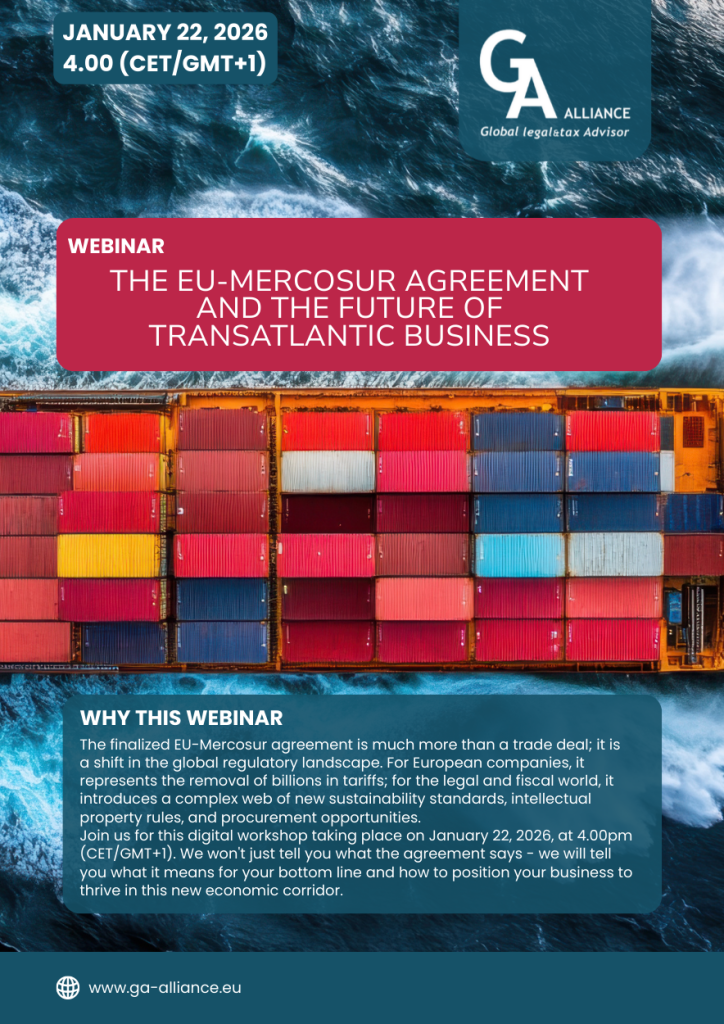
The EU-Mercosur agreement and the future of transatlantic business

Online Webinar by GA-Alliance

Online Webinar Event

The finalized EU-Mercosur agreement is much more than a trade deal; it is a shift in the global regulatory landscape. For European companies, it represents the removal of billions in tariffs; for the legal and fiscal world, it introduces a complex web of new sustainability standards, intellectual property rules, and procurement opportunities.

Join us for this online workshop taking place on January 22, 2026, at 4.00pm (CET/GMT+1). We won't just tell you what the agreement says - we will tell you what it means for your bottom line and how to position your business to thrive in this new economic corridor.


About GA-Alliance

GA-Alliance - an international law and tax firm with a global network spanning 80 countries and a team of over 2,600 professionals - is uniquely positioned to bridge these two worlds. Our multidisciplinary expertise allows us to navigate the intersection of international trade law and cross-border tax strategy with unparalleled precision.

Find us in the LATAM Area:

GA-Alliance

Knowledge Management

Mar 07 2024

DDL Capital

The draft law on measures to support the competitiveness of capital incorporates some of the measures most frequently represented by market operators aimed at increasing the competitiveness of the Italian financial industry and supporting the economy, by promoting measures to modernise the regulatory framework in light of the evolving dynamics of the markets and the growing competition between international financial centres.

In our newsletter, we have gone into these issues in detail: we invite you to download it and find out more about the Capital Bill.

GA-Alliance

Knowledge Management

May 23 2023

Radar on Brazil

Capital Markets

The Open Capital Market is coming! CVM President explains what it is


The Open Capital Market is an initiative introduced by the president of the Securities and Exchange Commission (CVM), João Pedro Barroso do Nascimento, aimed at strengthening and expanding the capital market in Brazil. The aim is to make the capital market more attractive, inclusive, and competitive, contributing to the country’s economic growth. The actions mentioned below are an integral part of this initiative:

  • Investor PIX: Instant and cost-free portability of investments between brokers via a mobile application.
  • Encouraging Activism: Increasing the engagement of individual investors in meetings by revising resolution 81.
  • Simplified Registration: Simplification of client registration by brokers, with a single shared registration.
  • Funds Framework: New regulatory framework for funds in force as of October, empowering investors.
  • Crowdfunding: Adjustments to crowdfunding rules to include small and medium-sized companies.
  • Review of takeover bids: Promise of a “revolution” in the way takeover bids are thought of in 2024.
    In addition to adjustments to existing regulations and the creation of new financial products, CVM aims to focus on the development of the following key sectors:
  1. Agribusiness: Despite accounting for around 25% of Brazil’s GDP, agribusiness still has a limited presence in the capital markets, accounting for only 5%. The CVM plans to expand the regulation of Fiagros in order to attract more participants from this sector.
  2. Sustainable Finance: The commitment to environmental issues offers significant opportunities for Brazil. The CVM is seeking to attract investors of different profiles to invest in sustainable finance.
  3. Cryptoassets: CVM recognizes the potential of cryptoassets as a way to modernize and innovate the capital market. It seeks to bring market players more in line with regulations and offer opportunities for different investor profiles who wish to participate in the organized market.
  4. Soccer Corporations (Sociedades Anônimas do Futebol - SAFs): With the implementation of Law 14.193/2021 (Sociedade Anônima do Futebol Law), the CVM is identifying opportunities for funds to invest in the soccer industry. It intends to adopt a similar approach to that of crypto assets.

In short, the Open Capital Market initiative promises to reinvigorate and expand the capital market in Brazil. Through innovative actions and strategic plans, it seeks to simplify the investment journey, increase investor engagement, and create a more favorable environment for the Brazilian capital market.

Investment Funds

New Rules on Brazilian Investment Funds Come into Force

On October 2nd, 2023, the new Resolution CVM 175 partially entered into force to regulate investment funds in Brazil. It is said partially because while most of the changes brought by Resolution CVM 175 came into force on October 2nd, 2023, there are still a few changes that will come into force only in 2024.

The Resolution groups 38 different already existing regulations into one and brings some important new rules about the formation, operation, and information disclosure of investment funds, as well as rules about investment funds’ services providers.

One of the most significant changes brought by Resolution CVM 175 is that it allows for the existence of limited liability funds. Up until the entry into force of Resolution CVM 175, only unlimited liability funds were permitted. Now, investment funds’ members may have their responsibilities limited to the value of their membership interest, so long as the funds’ regulation expressly establishes so.
Also, Resolution CVM 175 allows investment funds to invest up to 100% of its net asset value abroad, as long as they comply with the Resolution’s rules. Nevertheless, there are still limits for Financial Investment Funds (FIFs) that have foreign investments: the applicable limit for classes destined to the general public is of 20% of its net asset value, and the limit for classes destined exclusively to qualified investor is of 40% of its net asset value.

Another important change is the regulation of funds’ service providers. The investment fund manager will now have the title of an essential service provider, and, alongside the fund administrator, will perform the fund's core operational activities. This alteration was important to adjust the rules to the actual reality of the funds, that now usually have both an administrator and a manager.

Moreover, to guarantee more transparency to its members, the funds will have the obligation to disclose, in a separate manner, the administration, management and maximum distribution fees. That means that the funds’ regulations will have to disclose separately the remuneration of the administrator, manager, and distributors in its text. Previously, the funds only needed to disclose the fee as a whole; it was not necessary to disclose the information separately. It is important to note, however, that this obligation will only enter into force on April 1st, 2024.

Another significant alteration that will come into force only on April 1st, 2024, is the creation of a multiclass structure. The funds will be able to be divided into classes and subclasses, each of them having its individual assets, rights, and obligations. This means that the same set of assets can be linked to different liabilities without the need to create separate investment funds for each type of investor profile. This implies that assets can be grouped or associated with different liabilities or obligations, thus catering to the needs of different types of investors without the creation of
multiple separate funds. This will provide flexibility in investment management since the fund manager will not need to manage assets from more than one vehicle.

Resolution CVM 175 marks a significant milestone in the country’s financial sector, being a testament to Brazil’s commitment to creating a more transparent, efficient, and investor-friendly environment. Investment funds now have a new resolution that not only groups multiple regulations the country had about the theme, organizing the legal framework on the subject, and investors now have more enticing factors to invest in Brazil.

Labor law

Brazilian Supreme Court considers collection of contributions to unions valid


In a judgment concluded on 09/11/2023, the Federal Supreme Court (STF) considered the collection of the so-called assistance contribution valid. This contribution is intended to fund activities such as collective negotiations for collective work agreements.
In the decision, the STF makes it clear that the decision does not represent the return of the union tax, which was changed by the labor reform in 2017.

With the STF’s decision, the assistance contribution will now be charged to all workers, whether or not they are members of the union. However, for those who are not members of the union, the discount can only be made if:

  • The payment is agreed in an agreement or collective convention of the category.
  • If unaffiliated workers give express authorization for the discount, or do not present opposition within the period defined in collective bargaining.

Keep in touch!

Sign up for our newsletters!

Stay up-to-date on domestic and international legislative and tax news
and international, as well as all the Firm’s events and initiatives.

Back
to top