Paraguay

GA-Alliance operates in Paraguay through the law firm Legalcorp. Legalcorp is composed of a team of professionals with extensive experience in corporate and organisational legal advice and dispute management.


Specialised in private law, it offers an integrated system of comprehensive management and assistance, both remedial and preventive, to meet clients’ needs and expectations, guaranteeing highly competitive responses tailored to each client.

Find us

Asuncion

LEGAL CORP

Capitán Maciel No. 525 esq. Agustín Barrios

News from Paraguay

GA-Alliance

Knowledge Management

Bruxelles, Jun 04 2026

EU-MERCOSUR: STRATEGIC OPPORTUNITIES AND PRACTICAL IMPLICATIONS FOR ITALIAN BUSINESSES


EU-MERCOSUR: STRATEGIC OPPORTUNITIES AND PRACTICAL
IMPLICATIONS FOR ITALIAN BUSINESSES

Key takeaways from the DG TRADE Italian Edition discussion – 26 May 2026

INDEX

Executive Summary

The DG TRADE Italian Edition discussion on 26 May 2026 provided a practical overview of what the EU-Mercosur Agreement could mean for Italian businesses, placing the debate within a broader geopolitical and commercial context. The discussion made clear that the agreement is being framed not only as a trade instrument, but also as a strategic response to Europe’s declining competitive position in parts of Latin America, particularly in comparison with China’s growing economic footprint in the region.

A central message from the speakers was that the agreement would create opportunities for European exporters by reducing both tariffs and administrative barriers, while preserving EU regulatory standards. For Italian businesses, this could translate into stronger market access, improved protection for geographical indications, and a more predictable commercial environment in sectors where Italy has established strengths. At the same time, concerns around sensitive agricultural imports were directly addressed, with assurances that EU food safety requirements and market safeguard mechanisms remain fully in place.

Market Access, Competitiveness and Regulatory Simplification

Much of the discussion focused on the practical implications of the agreement for European companies seeking to expand in Mercosur markets. Speakers emphasized that the commercial value of the agreement goes well beyond tariff reductions. A major advantage lies in the reduction of non-tariff barriers that often make exporting costly and slow, including duplicative technical checks, burdensome certification procedures, and import authorization processes that create uncertainty for businesses.

The agreement was also presented as a strategic tool to strengthen Europe’s competitive position in Latin America at a time when Chinese firms have become increasingly embedded in the region. According to the speakers, European businesses currently face a structural disadvantage in markets such as Brazil and Argentina, where China has consolidated its presence while European market share has weakened. Because China does not currently benefit from an equivalent trade arrangement with Mercosur, the agreement could improve the relative position of European exporters, particularly in sectors such as automotive manufacturing, fashion, wine, and industrial goods where Italian companies are especially active.

Sector-Specific Implications and Strategic Considerations for Italy

A more technical part of the discussion focused on rules of origin, which will determine whether products qualify for preferential tariff treatment. Speakers acknowledged that these requirements can be complex and differ significantly depending on the sector, especially where supply chains rely on components sourced globally. This means that businesses will need to assess carefully whether their products can effectively benefit from the agreement in practice.
For Italy, the agreement was presented as especially relevant for industries that rely on quality, brand value, and product authenticity. The protection of geographical indications was highlighted as a concrete gain, with products such as Parmigiano Reggiano expected to benefit from stronger recognition and protection in Mercosur markets. Agricultural sensitivities were also openly discussed, particularly concerning beef imports, with the Commission underlining that monitoring tools and safeguard measures are intended to mitigate risks for vulnerable European sectors. The discussion also briefly addressed Mercosur’s evolving political composition, including Bolivia’s prospective accession and Venezuela’s continued suspension, both of which may shape future developments.

Conclusions

The discussion framed the EU-Mercosur Agreement as a strategic attempt to combine economic opportunity with geopolitical positioning, offering new openings for European businesses while seeking to preserve the regulatory safeguards and market protections that remain central to the EU’s trade approach:

    • The EU-Mercosur Agreement is being positioned as both a commercial opportunity and a strategic instrument to strengthen Europe’s presence in Latin America.

    • For Italian businesses, the most immediate potential benefits lie in improved market access, reduced administrative barriers, and stronger protection for high-value branded products.

    • Real commercial gains will depend on companies’ ability to navigate technical implementation issues, particularly rules of origin and product-specific compliance requirements.

    • While sensitivities remain in agriculture, the Commission’s message was that regulatory protections and monitoring mechanisms are designed to ensure that market opening does not come at the expense of EU standards or vulnerable sectors.

GA-Alliance

Eventi

Jan 22 2026

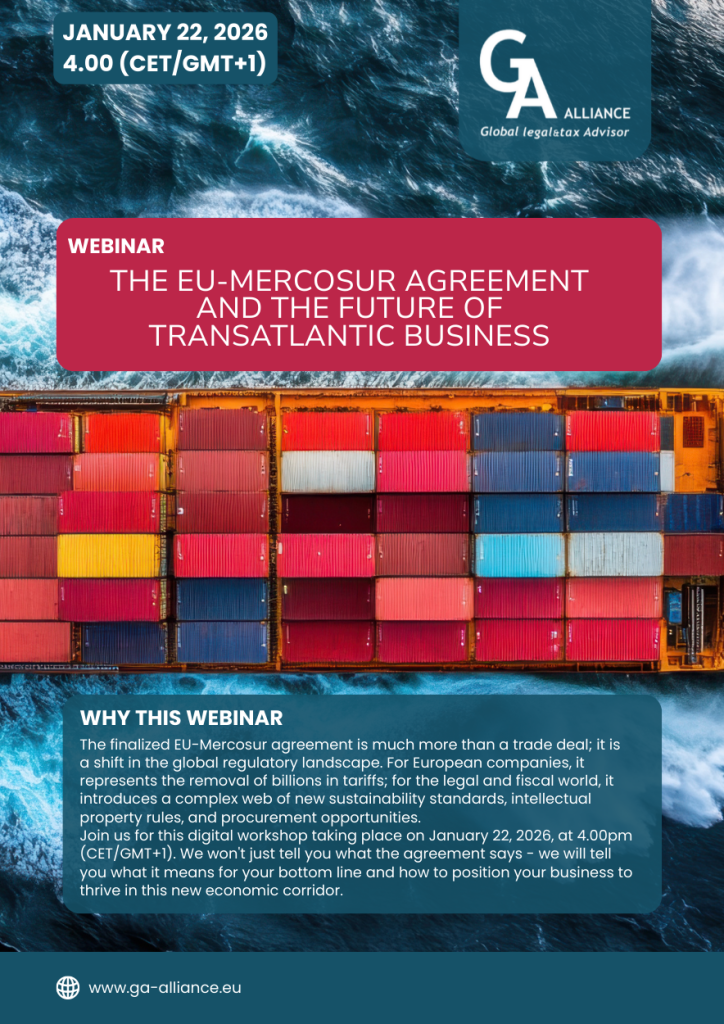
The EU-Mercosur agreement and the future of transatlantic business

Online Webinar by GA-Alliance

Online Webinar Event

The finalized EU-Mercosur agreement is much more than a trade deal; it is a shift in the global regulatory landscape. For European companies, it represents the removal of billions in tariffs; for the legal and fiscal world, it introduces a complex web of new sustainability standards, intellectual property rules, and procurement opportunities.

Join us for this online workshop taking place on January 22, 2026, at 4.00pm (CET/GMT+1). We won't just tell you what the agreement says - we will tell you what it means for your bottom line and how to position your business to thrive in this new economic corridor.


About GA-Alliance

GA-Alliance - an international law and tax firm with a global network spanning 80 countries and a team of over 2,600 professionals - is uniquely positioned to bridge these two worlds. Our multidisciplinary expertise allows us to navigate the intersection of international trade law and cross-border tax strategy with unparalleled precision.

Find us in the LATAM Area:

GA-Alliance

Knowledge Management

Oct 30 2024

Lens on Paraguay

Banking and Finance

Paraguay reaches investment grade for the first time in its history

The risk rating agency Moody's announced that it raised Paraguay's credit rating from Ba1 to Baa3, granting it investment grade for the first time in its history, reported the Ministry of Economy and Finance (MEF) on past July 24, 2024. Paraguay joins a select group of countries in the region to have the sovereign degree, Chile, Colombia, Mexico and Peru.

In a statement, they indicated that this stable outlook is reached after 26 years when the rating agency assigned a rating to Paraguay for the first time and after 9 years since the last upward review. "This unprecedented achievement is based on the country's solid economic fundamentals and its long history of macroeconomic stability," the MEF said.

They claim that it is the result of more than 20 years of responsible, consistent and predictable public policies. Prudent management of macroeconomic policies was able to achieve and preserve the sustainability of public finances and maintain low inflation

Tax

Agreement between Paraguay and Spain to avoid double taxation finally in force

After ratification by Paraguayan Law Nr. 7.271/2024 and publication in the Official bulletin of the Spanish Kingdom on July 29, 2024, said important agreement for the economic relationships between both countries shall be in force starting October 14, 2024, having effect for all tax purposes since January 1, 2025.

The agreement comprehends the Personal Income Tax, Corporate Tax and Non Resident income taxes in both countries (the so called IRP, IRE and IDU, and INR in Paraguay and IRPF, IS and IRNR in Spain) document observes OECD standards and includes measures to prevent tax base erosion and profit shifting (BEPS), affecting to Personal and Company income taxes in both countries (including income taxes for non-residents), which must now be ratified by the respective Congresses for its entry into force. Model Tax Convention on Income and on Capital 2017 shall be applicable for the interpretation of articles 5 (permanent establishment) and 7 (entrepreneurial benefits) of said Agreement.

Energy

Amendment of Law "On the Independent Production and Transmission of Electric Energy (PTIEE)"

On August 20224 Law No. 7299/2024 that amend Law Nr. 3009/2006 was enacted to foster private investments for the generation of renewable electricity through small hydroelectric plants (SHPs), by introducing correction of concepts that blocked the previous legislation to be applicable and improving the legal framework, by extending the threshold to grant licenses up to 50 MW and generation greater than 50MW should be subject to international public tenders, without the requirement of a risk-sharing contract with the national utility company (ANDE) as stated in the previous Law, although it retains a first call right to acquire the energy generated in case it is not exported or it is needed in the internal market.

Among other changes, the Ministry of Public Works and Communications replaced a Council of several Ministries (MOPC, Environment, Industry and Trade, Foreign Affairs) that made the procedure very bureaucratic. It must be clarified that shall Law is only applicable for the generation of electricity from the use of natural gas and/or minor hydroelectric generation, which also includes cogenerators and self-generators. This Law does not apply to other renewable energies (solar, wind) governed by Law No. 6977/2023, on Non-Conventional Renewable Energies (NCRE).

Public Procurement

Enactment of Decree Nr. 2264/2024, which regulates Law No. 7021 of December 9, 2022, "On Public Supply and Procurement".

This decree imposes a significant advance in what has to do with administrative management in public procurement. It seeks to improve efficiency, transparency and all flexibility in everything that has to do with public procurement processes. There are updates in terms of terminology, structure, facilitating reading and limiting the search for information and providing greater clarity to the management of State procurement, reducing the deadlines that have to do with protests, reconsideration appeals and deadlines for responses from public institutions to the DNCP.

A special type of bidding that he highlighted is joint procurement, which he described as an innovation in public procurement. It consists of public institutions coming together to buy goods or services, in search of efficiency through the implementation of economies of scale and administrative standardization. The annual average of the awards is USD 3.246 million, with 9.513 procedures and 3.266 suppliers.

Keep in touch!

Sign up for our newsletters!

Stay up-to-date on domestic and international legislative and tax news
and international, as well as all the Firm’s events and initiatives.

Back
to top